
South Carolina Resident Search Order
Choose the county before you search. South Carolina has 46 counties, and each one keeps its own tax, land, probate, and local court records. A name search works best when you know the likely county. An address search works best when you first match the street to a parcel. If you are tracing an older household, a library or archive may hold the only index that reaches the right year. For the street-by-street order, follow the South Carolina street directory method after you have a county and address.
Public sources answer different questions. The assessor lists tax owners. The voter office lets a person confirm a registration. A deed names parties to a transfer, and a directory can place a listed adult at a street in a past year. None is a complete count of everyone who lives at an address. A person may use a trust, receive mail elsewhere, move, or be covered by a safety program. Treat each result as a lead, then check its date and record type.
When browsing a South Carolina residents directory, keep each roll tied to its actual custodian and date. A county tax record, a voter confirmation, and a historical book answer separate questions even when they share a name or street.
- Set the county from the street address or the person’s last known town.
- Use that county assessor’s name or address search to find a tax parcel and its TMS or PIN.
- Check MySCVotes only when you have the person’s name, county, and date of birth.
- Use the deed index, court roster, or local directory for the kind of link you need.
- Ask the named custodian, courthouse, library, or archives for records outside the web index.
Where South Carolina Keeps Resident Records
South Carolina has no one office that keeps a statewide resident list. County assessors and GIS offices map parcels; county Registers of Deeds, or Clerks of Court that perform that role, record deeds and plats. County Clerks keep trial court files, while Probate Courts handle estates and older marriage licenses. The South Carolina Election Commission keeps voter records. The Department of Public Health handles vital records. The South Carolina Department of Archives and History (SCDAH) helps locate older county and city holdings.
South Carolina Archives
Research Room
Tuesday to Friday, 8:30 a.m. to 5 p.m.
803-896-6104 / 6105
South Carolina Vital Records
Department of Public Health
Mail: P.O. Box 2046, West Columbia, SC 29171
Regional offices issue state birth copies
South Carolina Election Commission
1122 Lady Street, Suite 500
Columbia, SC 29201
803-734-9060
South Carolina County Record Paths
The same search can lead to a different office when a county line, town line, or old district name changes. South Carolina has four broad regions often used for local context: the Upstate, Midlands, Pee Dee, and Lowcountry. These regions do not replace county jurisdiction. A record search should begin with the county named in an address or case entry, then move to the town office when the record is a city permit, cemetery entry, or municipal case.
The county chain has a clear order. Start with the assessor or GIS to identify the parcel. Go to the Register of Deeds for the legal transfer. Use the Clerk of Court or Probate Court for a case or estate. The Treasurer or Auditor can add tax status, but a tax bill may reflect a statutory tax date rather than the latest deed. SCDAH’s county guide helps when an older record was filed under a district or parish name.
South Carolina records also follow older boundaries. Much county business ran through Charleston before 1785; county units served from 1785 to 1799, districts from 1800 to 1868, and counties returned under the 1868 constitution. A nineteenth-century deed or court entry may therefore use a district, parish, or earlier county name. The modern county usually owns the current parcel, while SCDAH’s maps and local-record guide can identify the older series or office that holds an earlier book.
Note: Columbia is the state capital. South Carolina has no statewide county seat; every county has its own courthouse and seat.
South Carolina Property Roll Searches
A county tax roll can tie an owner to land, but South Carolina has no official statewide owner-search portal. Richland County’s property search accepts an owner, address, or tax map number. Charleston County’s Auditor and Assessor search offers separate name, address, parcel ID, and sales-date routes. The parcel identifier is called a TMS or PIN in local systems. A parcel card may show value, exemptions, improvements, a sketch, and a deed reference.
Keep the situs address and tax mailing address apart. Situs means where the land sits. Tax mail may go to a post office box, business, agent, or person in another county. A legal-residence or homestead marker is a tax classification, not proof that an owner sleeps there now. When an online form gives no result, call or visit the county office, ask for the public terminal, or make a narrow South Carolina FOIA request for an existing record.
| Portal field | Format and use | Limit |
|---|---|---|
| Charleston, Last / First / Middle Name | Separate text fields for a named owner | Search behavior should be checked on the live portal. |
| Charleston, Street Number and Street Name | Address search; omitting St. or Ave. can improve results | Use TMS when an address has more than one parcel. |
| Charleston, Parcel ID (TMS) | Text number for a parcel search | Not a statewide identifier. |
| MySCVotes, Name / County / Date of Birth | All three are required and should match the voter card | Individual check, not a reverse address search. |
- TMS or PIN
- The county parcel identifier used to connect a mapped lot with its tax card and recorded instruments.
- Situs address
- The physical location of land; its tax mailing address may point somewhere else.
- Tax roll
- A county assessment record organized around parcels and tax owners, not a list of every occupant.
South Carolina Voter Roll Access
The state’s MySCVotes registration check is a personal lookup. It asks for name, county, and date of birth as they appear on the voter card. A matching active result may show status, precinct, district, polling place, and election participation. It does not show a ballot choice. South Carolina does not register voters by party in the usual party-registration sense.
The public voter file is a separate product. A buyer must be a registered South Carolina voter under S.C. Code §7-3-20(D)(13). The file can be filtered by county, voting district, age, sex, race, household, election participation, or registration date. A base electronic file of 1,000 to 5,000 records costs $25 in the research source. S.C. Code §30-2-50 bars using personal information from a public body for directed commercial solicitation. County election offices also answer record questions in person or by phone.
South Carolina Court Name Search
The South Carolina Court Roster Search landing page routes a search by county, city, or ZIP code to a county portal. Most counties use Public Index; Charleston has its own case system. The statewide page does not display one shared set of case fields. County pages vary, and a name hit may be a different person with the same name.
Save the case number, court, division, county, filing date, and displayed status. A roster may show only a hearing or brief event. The Clerk of Court can explain how to view the full file, obtain an older case from storage, or request a certified copy. Municipal ordinance matters remain with the local court. Federal cases are separate and use PACER. Sealed, juvenile, adoption, expunged, and protected family details may not appear.
Public Rolls for South Carolina Residents
South Carolina’s useful public lists serve distinct purposes. A property roll names tax owners, a voter check confirms one registration, and the court roster lists parties to public cases. The table keeps those roles distinct. These records are not a count of everyone in the state, and each office has a separate legal and geographic scope.
| Source | Who It Lists | Keeper | Access |
|---|---|---|---|
| County tax roll | Current tax owner and parcel details | County assessor | County portal or office; coverage varies |
| MySCVotes | One voter’s registration and district details | South Carolina Election Commission | Name, county, and date of birth required |
| Register of Deeds index | Parties to recorded deeds and other instruments | County ROD or Clerk | Web index, courthouse terminal, books, or film |
| State Court Roster | Parties and events in public cases | County court system | Online route plus clerk access |
| Unclaimed property | Money held in a person’s, heir’s, or business name | State Treasurer | Free search; proof is needed to claim |
Start with the assessor for an address and owner question, with the voter check for an individual registration question, and with the court portal for a named case. Deed indexes show recorded legal transfers, not every household member. When one name needs checking across several record types, use the resident lookup sequence described in the relevant section below.
Treat a South Carolina residents directory match as a pointer and confirm it with the named office. The date on the record matters as much as the name: tax rolls, case rosters, and registration results change on different schedules.
South Carolina FOIA Request Routes
The South Carolina Freedom of Information Act is in S.C. Code §§30-4-10 and following, with the request rule in §30-4-30. There is no single state form for every agency. Name the office, the record, the town or county, and a date range. A specific request for an existing file is easier to route than a request for a new statewide list, which an agency need not create.
The Election Commission provides one clear example. Its election records request form asks for the requester’s name, registration status, contact details, record description, intended use, and any supporting file. It accepts web, email, fax, or mail requests. The initial decision is due in 10 working days for records less than 24 months old, or 20 working days for older records. If release is due, production normally follows within 30 or 35 calendar days.
For another public body, send the request to the agency or local custodian that holds the record. Identify the record type, county or city, name or parcel, and a date range; ask for an existing file rather than a newly assembled statewide list. Under South Carolina FOIA, a body may charge actual search, retrieval, and redaction costs, may ask for a deposit up to 25 percent, and cannot charge more than prevailing commercial copy rates. A request for one permit file or deed image is easier to route than an open-ended research question.
A copy of the South Carolina Election Commission FOIA page shows the fields a voter-record request asks the reader to supply.
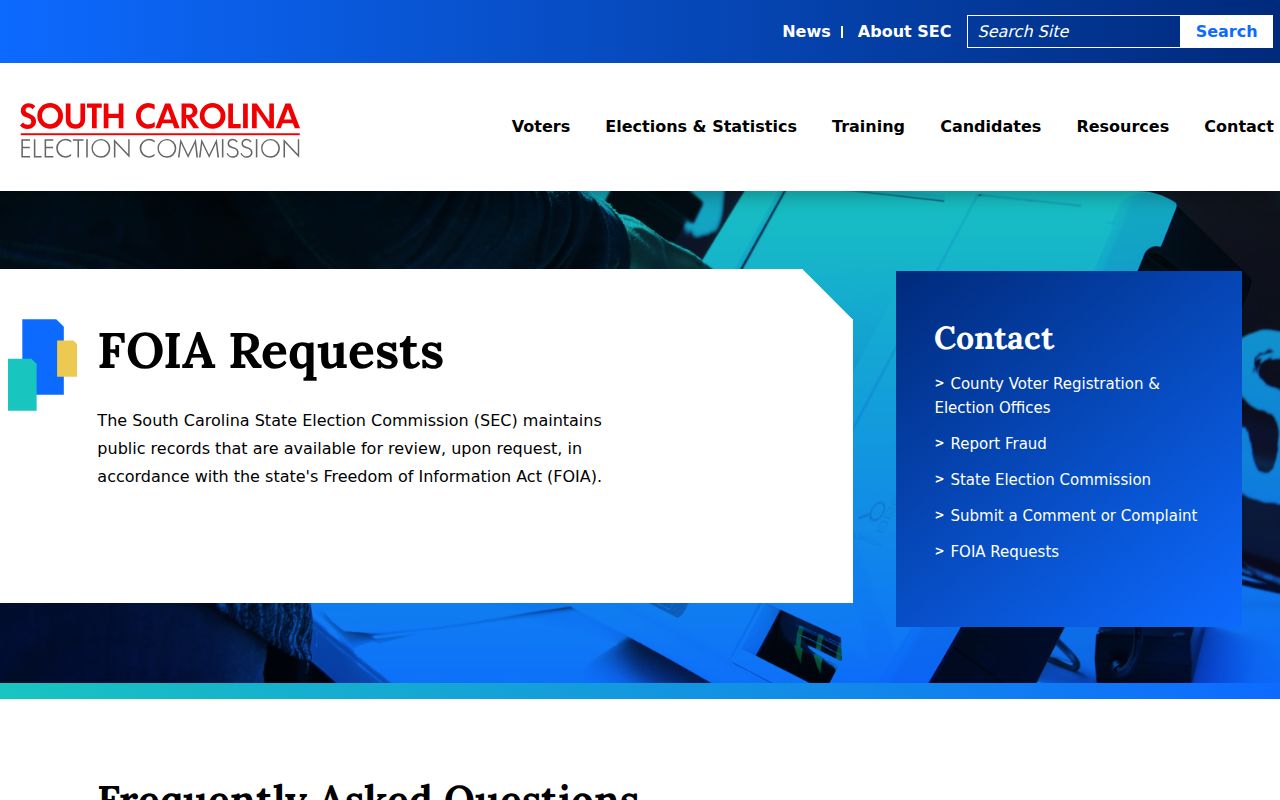
The form is for election records. Other records go to the agency, county, city, or court that holds them, and protected details remain closed under their own rules.
South Carolina Vital Record Rules
South Carolina vital records do not all open on the same schedule. DPH has birth records from 1915. Birth copies stay restricted until 100 years have passed, while death records open to any person after 50 years with enough details to locate the record. Before those dates, the applicant must meet a statutory access route. A genealogy index can help find a date, but it is not the same as a certified copy.
Marriage and divorce records split between offices. County Probate Courts hold marriage licenses from before central filing began on July 1, 1950; DPH keeps the central marriage files from that date onward. DPH divorce reports begin July 1, 1962, but the Clerk of Court holds the decree and case file. DPH’s current guidance explains approved online vendors, regional offices, and mail requests. The researched birth form lists a $12 search fee with one copy if found, $3 for another copy, and a $17 expedited option for eligible non-mail service. Check the live fee page before sending money.
For a birth request, DPH uses its current application, identity document, eligibility information, and payment; the form asks for the registrant’s name at birth, date and county, and parent names. Mail requests go to the Vital Records Section, P.O. Box 2046, West Columbia, SC 29171. Regional offices can issue statewide birth copies, but amendment work may be routed to the central office. Older church, cemetery, newspaper, and probate material can support family research without replacing a certified record or changing access limits on a recent vital file.
South Carolina Archives and Old Records
A missing web result may point to an older book, a film reel, or a record kept under an earlier government name. The SCDAH Online Records Index includes will transcripts from 1782 to 1855, land-grant plats from 1784 to 1868, criminal court records from 1769 to 1891, Confederate veteran records, school insurance photos, and other selected series. Index coverage differs by record group, so note the collection title and date span before asking for a copy.
The statewide guide reports thousands of local series and microfilm reels. Its county and municipal guide gives a path to books, minutes, plats, and film held by local offices or the Archives. Depression-era CWA and WPA transcripts may be the only surviving copy when an original local record was lost. The two published series totals in the research differ because the guides describe separate counts and scopes; use the guide itself rather than combining them into one number.
In May 2025, SCDAH made collection P900035 searchable at item level. Select “Item Level” and try a county or town name with “map” to find boundary or street sheets. Research room hours in the source are Tuesday to Friday, 8:30 a.m. to 5 p.m., and Saturday, 8:30 to noon and 1 to 5; call 803-896-6104 or 6105 before a trip.
South Carolina Heir and Property Search
Unclaimed property can be a useful lead when someone moved, died, or changed a name. The State Treasurer’s free search covers property held under an owner, heir, business, or other listed name. A possible match is only a claim lead. The claimant must send the documents the Treasurer asks for, and a relative may need proof of the link to the owner.
The South Carolina Treasurer’s Unclaimed Property page links the name search, claim-status check, document upload, and report-property route.
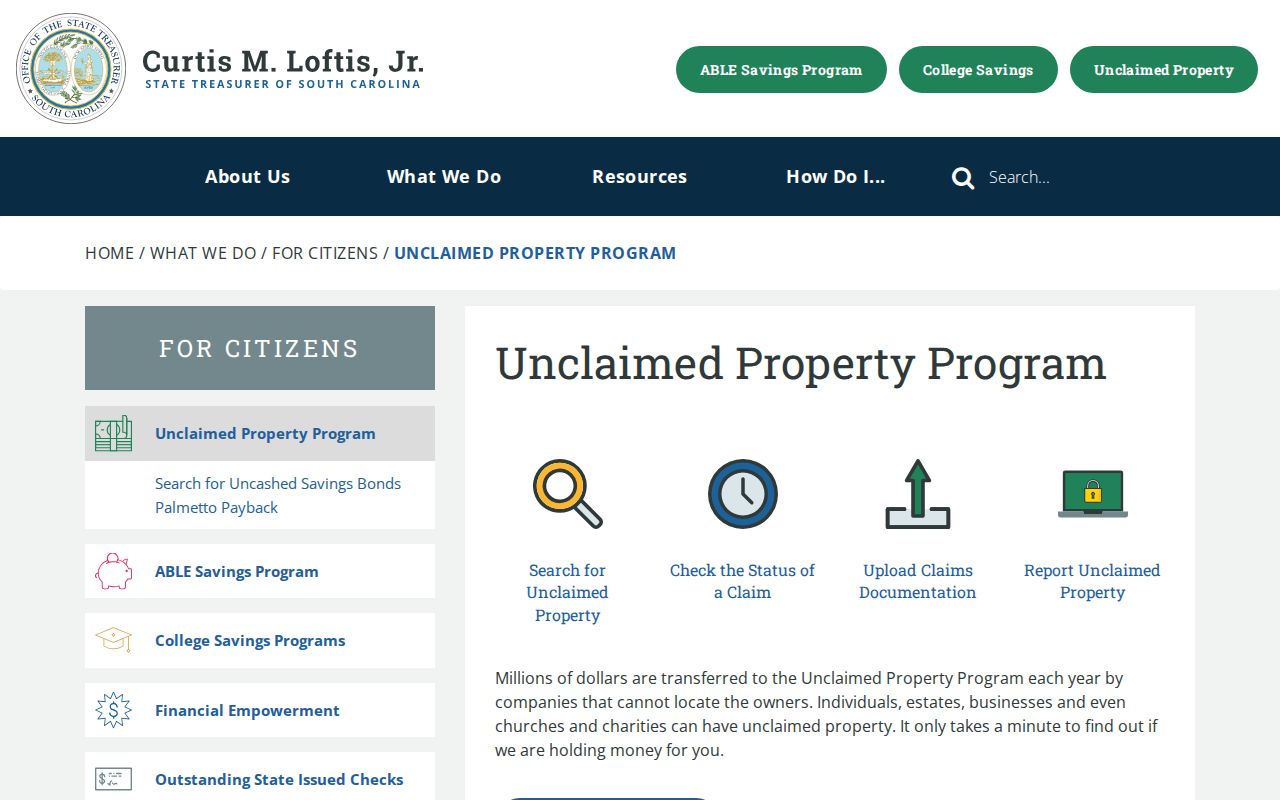
The claim process makes this source useful for family research, but a name match alone does not prove identity. Keep the claim file with the Treasurer and use the relevant county Probate or deed record to check a family or property link.
Holdings can represent uncashed checks, deposits, insurance proceeds, dividends, or other property transferred to the state after its owner could not be located. Search spelling variants and a prior surname, then compare the listed holder or address with a known family timeline. The search is free, while the later claim depends on evidence such as identification, proof of address, estate authority, or documents connecting an heir to the named owner. The Treasurer’s claims team decides which proof is needed for each item.
South Carolina Privacy and Safe Use
The Family Privacy Protection Act, S.C. Code §§30-2-10 through 30-2-50, restricts using personal information from a public body for commercial solicitation directed at someone in South Carolina. The state’s Address Confidentiality Program gives qualifying survivors a substitute address for state, county, city, and court dealings. It began in 2025 and can forward mail, but it does not erase old public records or bind private firms to use the substitute address.
Public does not mean current or complete. A stale parcel card, voter entry, or court roster can point to a different person or an old address. Ask the custodian how to fix an error. Use the agency’s own redaction process for protected details, and do not copy a private address into another public list.
| Check | Official custodian | Compiled people-search index |
|---|---|---|
| Source trail | Names the county or state office and record type. | May combine public records, address or phone data, and purchased datasets. |
| Correcting an error | Ask the office that created or holds the record about its correction route. | An opt-out request does not change the source record. |
| Confirming a match | Check the date, parcel, case, or registration with its custodian. | Similar names may be combined; verify each detail independently. |
Personal use. Use public records for family history, civic research, or a lawful personal purpose. South Carolina law bars certain solicitation uses, and threats or harassment should be reported to local police.
South Carolina's Historical Resident Rolls
The South Carolina historical shelf has strong Columbia runs and smaller town sets. USC and Richland Library’s digitized Columbia collection covers 1859 to 1927, with volumes by Hill, R. L. Polk, and Walsh. A separate digital group has searchable listings from 1859 to 1922 for Anderson, Camden, Chester, Clinton, Gaffney, Laurens, Newberry, Sumter, and Union. The South Carolina city directory collections page covers the volumes and local library routes in more depth.
Directory pages can show a name, spouse note, occupation, and address, but each book follows its own rules. An “r” can mark a residence, while “wid” signals a widow under the publisher’s convention. Search a scan as well as its OCR, since old type can turn a letter into a different name. A directory entry is one year’s snapshot, not proof of a later address. Pair it with a census, deed, obituary, or probate file before you draw a family link.
A name in the South Carolina residents directory is one clue alongside the page, year, town, and publisher that produced it. Verify an old address against the source image and a separate record before carrying it into a family timeline.