
South Carolina Directory Collections and Runs
South Carolina has no single complete city directory series. Columbia has the broadest verified digital run. A USC collection also holds listings for other towns, but their years differ. Greenville libraries, the State Library, SCDAH, and local history rooms add print, microfilm, catalog records, and help finding missing volumes. The table describes collections with confirmed places or date spans; no statewide last publication year is known.
| Collection | Years | Where Held | Access |
|---|---|---|---|
| Columbia directories, Hill / R. L. Polk / Walsh | 1859-1927 collection; sampled 1899, 1905, 1922 | USC/Richland digital collection and local shelves | Free scans and transcripts online |
| South Carolina multi-town collection | 1859-1922; town years vary | USC Digital Collections / South Caroliniana | Searchable text and page scans |
| Greenville and Upstate printed directories | No complete statewide year list found | Greenville County Library South Carolina Room | Ask staff about catalog, microform, and local runs |
| Reverse or criss-cross books | Town and year runs vary | City library, State Library, USC, or licensed database | Library access or subscription may apply |
| Charleston city directories | Historical Society collection begins in 1782 | South Carolina Historical Society library | Consult local property files and historic maps too |
A listed annual run does not mean every annual book survived. A town may have a gap, a publisher change, or an edition that is held only in print. Search the town and county library catalogs before deciding a year is lost. The USC directory collection is free to browse, and library staff can check local shelves, microfilm, licensed databases, or interlibrary loan when an online scan stops short.
- 1859: beginning of the verified Columbia digital collection.
- 1899: an inspected Columbia volume carries Hill Directory Company metadata.
- 1905: the Columbia volume identifies R. L. Polk & Co.
- 1922: a Walsh Directory Company Columbia volume provides the sampled business page.
- 1927: end of the Columbia collection’s verified span; the mult-town collection ends in 1922, with town coverage varying.
This timeline describes verified volumes, not an unbroken annual publication run. A catalog’s date range may include gaps or different editions, so use the item record for the particular town and year rather than treating the endpoints as proof that every intervening issue survives.
South Carolina Columbia Directory Publishers
Columbia’s directory history spans changes in publisher and page design. The USC/Richland digital set covers 1859 to 1927. Its inspected 1899 metadata cites Hill Directory Company, the 1905 volume names R. L. Polk & Co., and a 1922 volume credits Walsh Directory Company. Those labels help identify a year and can explain why the page layout or short forms shift across the run.
Publication frequency is not the same as survival. One digitized Union-directory advertisement describes Greenville as annual, Anderson as every 18 months, and some other towns as biannual, but it is a market note, not a full list of extant issues. A missing year may survive only in a county library, special collection, or microfilm cabinet.
That advertisement reflects what one publisher offered in its service area, not what a library owns now. For example, the printed frequency for Greenville and Anderson differs, while a town’s surviving shelf can have a larger gap than the planned schedule. Treat an advertisement as evidence of the directory trade and use USC’s catalog, SCLENDS, and the local history desk to identify the actual volume. A nearby county system may hold a year absent from the town’s own catalog.
The 1922 Walsh Directory Co. sample is a 613-page Columbia volume. The scanned page shows how one book can mix resident names with business classifications.
Page 575 contains business headings, names, street addresses, and building or telephone context, so use the book’s section label before treating an entry as a home address.
When a family address appears on a business page, check the alphabetic section for a separate personal entry. A commercial listing may give a storefront or business location while the resident entry gives an address after “r.” The sample is useful for how Columbia books arrange information, but it does not establish the format in every town or publisher. Save both the printed page and the collection’s item record so the business and household references remain distinguishable.
The publisher imprint is a useful locator: when a name appears under a business heading, inspect the alphabetic resident pages before assuming the address is a home. Likewise, a residence abbreviation such as “r” points to where the person was listed, while the employer or shop address may appear earlier in the same line. Keep page number and section title in your citation so another reader can reopen the same part of the volume.
Reading a South Carolina Directory Entry
A South Carolina city directory entry often gives a name, a spouse or relation note in parentheses, an occupation, a business address, and a residence marker. In the Columbia 1905 volume, an “r” marks a place of residence; “wid” and “Miss” follow the publisher’s period style. A business owner may appear once in the classified section and again by name. Read the scan beside OCR text, because small letters and abbreviations are often misread.
| Name | Indexed surname, given name, initials, and suffix |
|---|---|
| Household note | Spouse or relation in parentheses; “wid” in some entries |
| Occupation | Trade or work role, sometimes with a business name |
| Address | Street or neighborhood; “r” commonly marks residence |
| Business page | Classified trade listing may repeat a person or firm by name |
- Criss-cross section
- An address-ordered part of a directory that can lead from street number to listed person.
- Householder index
- A name list for the main person recorded at an address in that volume.
- Abbreviation key
- The volume’s guide to short forms; read it before expanding an old label.
A Columbia 1905 entry captured in the research illustrates the compressed style: Alonzo Summer is followed by a work reference and a residence marker for Meeting Street in Brookland; Charles E. Summer Jr. appears with “(Erne),” an occupation, and a residence on Sumter Street. These are useful clues, but a transcription may omit punctuation or confuse a letter. Open the scan, read the column heading, and check nearby lines before expanding a short form. Treat period language as the book’s own notation rather than a current category.
Ownership or occupancy marks are not uniform across publishers, and the inspected sample does not establish a statewide code. If a volume explicitly marks an owner, boarder, widow, or household relation, transcribe the mark and its key exactly; do not infer status from an occupation or from the person’s position on the page. A listed adult can be a relative, boarder, or business operator rather than the property owner.
South Carolina Multi-Town Directory Sets
USC Digital Collections holds full-text searchable listings from 1859 to 1922 for Anderson, Camden, Chester, Clinton, Gaffney, Laurens, Newberry, Sumter, and Union. The set has scans and transcripts, but each town’s exact surviving years should be checked in the collection record. A volume may list a resident, firm, and street, yet a town boundary can leave a nearby rural address outside the book.
Use the State Library’s SCLENDS catalog when the USC scan stops or when the target town is missing. A catalog result can lead to another county’s print volume or microform. Ask the local library whether the item is on an open shelf, in a supervised local-history room, on film, or in a licensed database. Exact subscription years differ by library system.
The verified mult-town names are Anderson, Camden, Chester, Clinton, Gaffney, Laurens, Newberry, Sumter, and Union. A listing in that collection does not imply an equal run for all nine places, and it does not automatically include a nearby suburb or rural route. Search both the town and county names in the catalog; older volumes may use a county seat, post-office name, or historic neighborhood as the catalog subject. When OCR returns no result, browse the scan by surname letter and check the address section directly.
Keep the item title and page image together when saving a citation. The text transcript makes it quick to test name variants, but the scan can show whether an apparent abbreviation belongs to that person or the next line. If the right town is missing from the digital run, search SCLENDS and the library’s local-history catalog for “Polk,” “directory,” “reverse directory,” “telephone,” or the county name. Ask whether another branch holds a print or microfilm year before concluding that the volume was never published.
South Carolina Local History Rooms
The Greenville County Library South Carolina Room combines databases with family files, manuscripts, maps, microform, newspapers, photographs, reference books, and research computers. Its staff include genealogists and historians; appointments are recommended. Email scroominfo@greenvillelibrary.org to ask about the right collection and available appointment. Local staff may know an unscanned city directory year that a statewide web search cannot show.
The South Carolina Room collection page describes its books, research computers, and contact route.
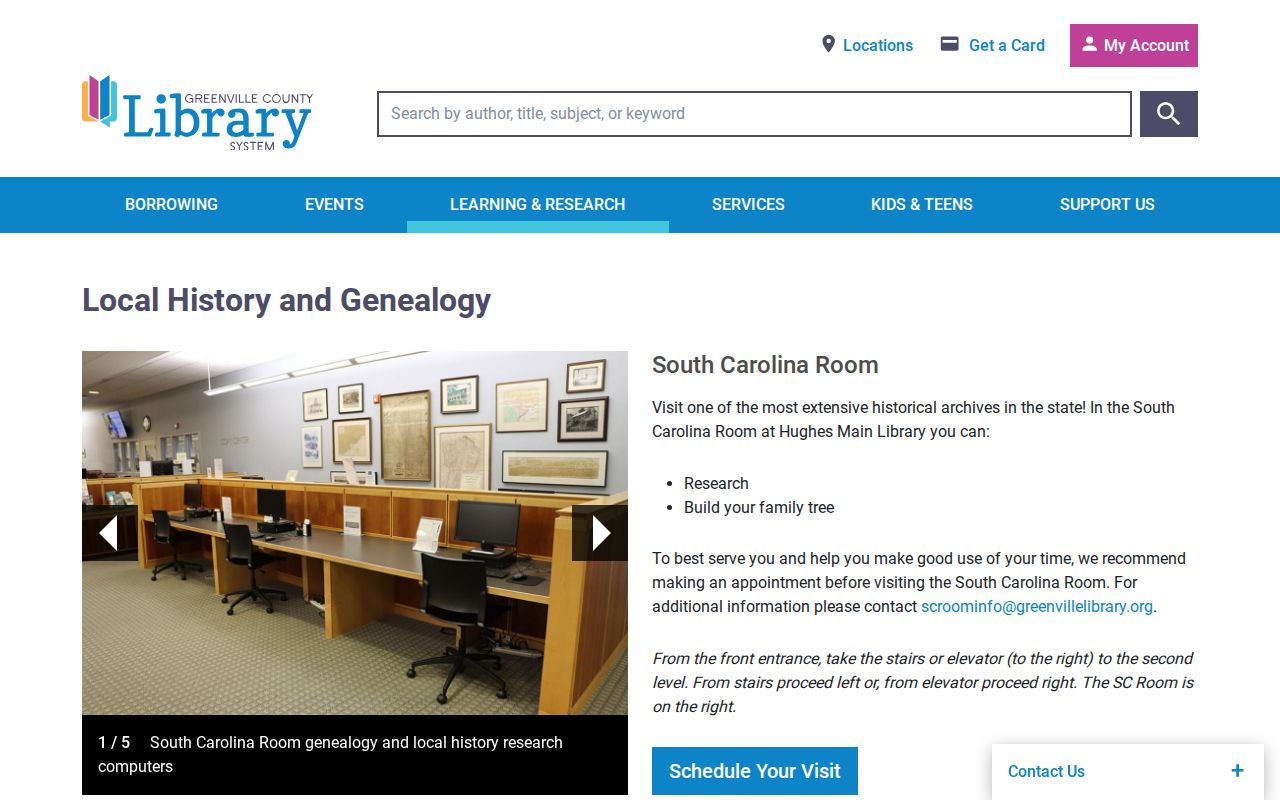
Bring a town, surname, address, and approximate year. Staff can point to a catalog item or reference service, but a collection record does not promise that every name is indexed.
For an appointment, ask specifically whether the relevant year is a print book, microform, newspaper file, or database and whether a reader or advance retrieval is needed. The room also holds local maps, manuscripts, photographs, family files, and research computers, so a directory entry can be checked against more than one kind of material. The library recommends an appointment and lists scroominfo@greenvillelibrary.org for collection questions. A focused request with the surname spelling, town, street, and date range helps staff identify the right catalog entry.
South Carolina Archive Indexes and Maps
SCDAH helps bridge a directory search to public local records. The Online Records Index includes wills from 1782 to 1855, Confederate veteran records from 1909 to 1973, land-grant plats from 1784 to 1868, criminal court records from 1769 to 1891, and selected school insurance photographs. The indexes differ, and many offer only some images. Search the record-group title, county, person, and date, then ask about the original or microfilm if the index ends.
The South Carolina Archives online research gateway links its index and research room services.
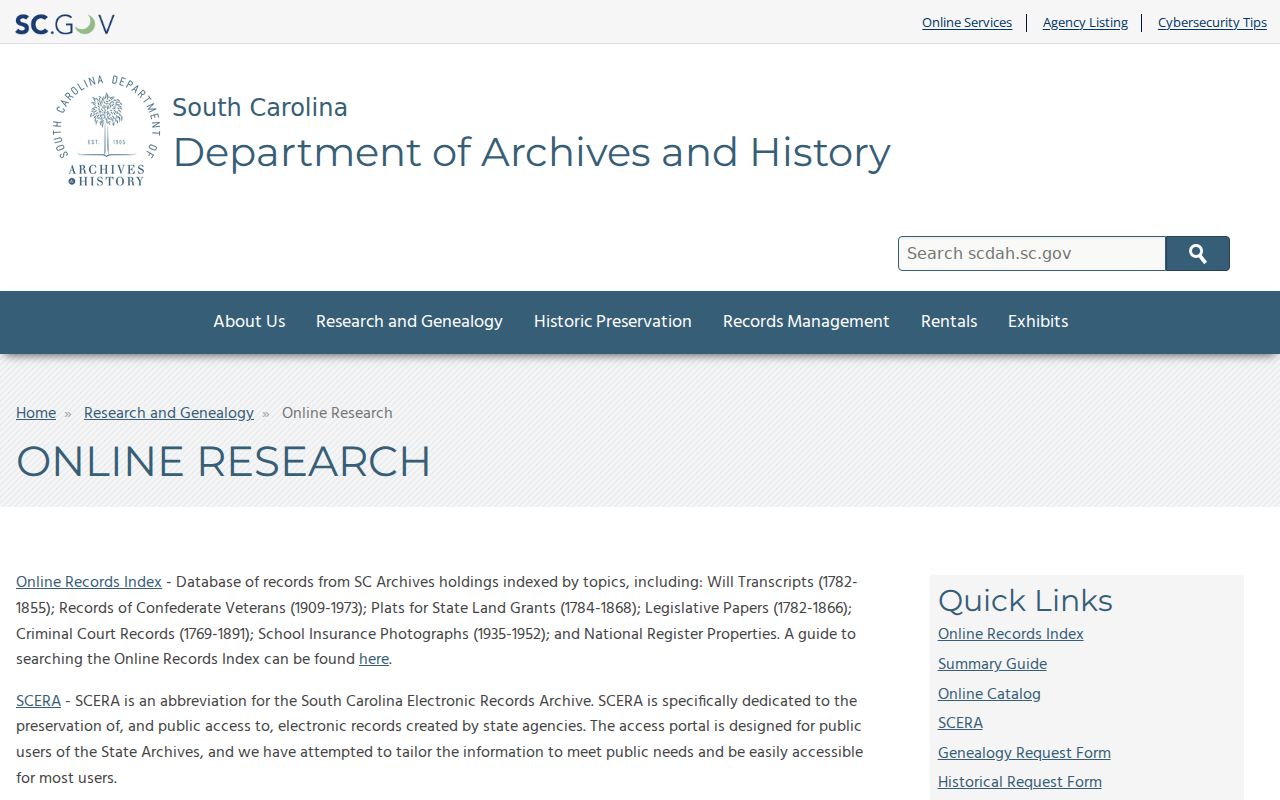
SCDAH’s research room is open Tuesday through Friday, 8:30 a.m. to 5 p.m., and Saturday, 8:30 a.m. to noon and 1 to 5. Call 803-896-6104 or 6105 before a visit; film readers and paper records supply a route when no scan appears.
The Archives gateway is a finding aid, not a replacement for the local commercial directory collections. Its value is the second half of a family trail: wills, land plats, court records, veterans’ files, school insurance photographs, and local series can verify relationships, property descriptions, or a neighborhood name found in a directory. The Summary Guide includes thousands of county and municipal series and reels; the published totals vary by guide and scope. Search by record group and county, then ask staff which original, transcription, or microfilm belongs to that series.
USC and local libraries also preserve historic newspapers, council minutes, yearbooks, maps, and obituaries that can supply a date or relationship absent from the directory. FamilySearch’s South Carolina collection list includes Charleston death records from 1821 to 1926, birth registers from 1901 to 1926, and county marriage and estate materials; some images have account or affiliate-library access limits. Treat those entries as research leads and check the institution’s access note before planning a visit or assuming an image is open online.
South Carolina's Charleston Directory Collection
The South Carolina Historical Society’s research guide places its Charleston city-directory collection from 1782 through the twentieth century. It also points to deed books, property files, Sanborn sheets, and historic maps as companion sources. This is a useful Charleston route when a family name appears in a city directory but the older parcel record uses a lot or plat description instead of a current street number.
Ask the library whether the volume is on an open shelf or needs staff help, and record the call number, edition, and page. The State Library’s SCLENDS catalog can show if another library holds a related year. A catalog record helps find the book; it does not mean a name search exists online.
The Charleston collection reaches earlier than the digitized Columbia run: the Historical Society guide describes volumes beginning in 1782 and continuing into the twentieth century. Its house-history guide also points researchers toward property files, Sanborn coordinates, maps, and deeds. This is useful when a directory gives a surname and an old street location but no modern parcel number. First identify the edition and the spelling printed in it; then use the map or deed description to connect that entry to the later street grid.
South Carolina Family Names Across Directory Years
A directory can help reconnect a family line when a relative’s town or street is known but a surname spelling has shifted. Start with the nearest Columbia or town volume, then search the alphabetic entry under a middle initial, spouse name, or variant spelling. Follow an address across adjacent years and use an obituary, church register, cemetery note, or Probate file to test whether the family connection is sound. A library reference worker can help locate a missing year or identify an old publisher abbreviation.
Keep the search respectful and limited to historical or family research. A person’s absence from a printed volume may reflect a move, the book’s boundary, or incomplete coverage rather than a death or deliberate concealment. Where a record points to a current person, use the official custodian and its access rules; do not infer a modern relationship from a century-old address alone.
Trace South Carolina Families by Year
A South Carolina city directory can show a year-to-year address sequence. A census can add a household snapshot, while deeds confirm title and Probate or an obituary may explain a move or death. Keep the name, street number, town, publisher, year, and page together. Pair the closest directory year with a census year, but remember that a directory can be annual and city-limited while a census is a single count date.
- Choose a town and the nearest year that survives in the library or digital collection.
- Search the alphabetical section for name variants, initials, spouse notes, and publisher abbreviations.
- Check the address-order section for the street and nearby numbers.
- Compare the next available year and pair it with the closest released federal census.
- Use deeds, probate, obituary, cemetery, or local papers to test the family link.
A name dropping out does not by itself show that someone died. The person may have moved beyond the town list, been omitted in a thin year, changed a name, or appeared under a spouse. A directory find that needs a modern name check can be compared with the official steps on the South Carolina resident lookup page, using only records open to the requester.
For a family history, keep two parallel timelines: one for the people named in each book and one for the land or building. Use the directory to note address, occupation, spouse notation, publisher, edition, and page; use deeds for ownership, census schedules for household composition, and obituaries or probate for a death or heir relationship. A person can leave the directory because the family moved, the book’s coverage changed, or the spelling shifted. Check the next surviving year and a nearby census before drawing a conclusion from a missing name.