
South Carolina Previous Residents by Era
South Carolina offers different tools for each era. County web indexes cover only part of some deed runs; a library or archive may hold earlier books, film, or a directory that never went online. Previous residents may appear as owners in one record and as listed people in another. The table names the verified examples and keeps each coverage claim tied to its actual source. A blank year means the research did not find a complete statewide run.
| Source | Years It Covers | Where Held | What It Shows |
|---|---|---|---|
| Charleston Register of Deeds | 1978-present index; images from 1997 | ROD site, books, Archives Room, film, in person | Recorded parties, deed and mortgage chain |
| Richland Register of Deeds | 1984-present index; images from 1998 | Subscription site or courthouse | Owner, tax map, legal description, book/page |
| Columbia city directories | 1859-1927 collection | USC/Richland digital collection, library shelves | Listed resident, spouse note, occupation, address |
| Other South Carolina town directories | 1859-1922 collection, town years vary | USC, South Caroliniana, local libraries | Resident or business address |
| Federal census | Public through 1950 as of 2026 | National Archives, Census, FamilySearch | Household, age, relation, occupation, residence |
| Sanborn maps | About 1880s-1960, editions vary by town | USC, Library of Congress, local library | Building footprint, materials, use, street |
| Permits and code records | Local; statewide start date not found | City or county portal, office, or FOIA | Work dates and named project parties |
| Obituary and probate | Local runs vary; SCDAH will transcripts 1782-1855 | Newspaper, library, Probate Court, SCDAH | Death, heirs, executor, last address |
For a recent ownership question, start with the current assessor card and its deed reference. For a household before the online cutoff, search a city directory, census year, Sanborn sheet, or county book that overlaps the period. A probate file can connect a deceased owner to an executor or heirs. The right choice depends on whether the question concerns title, a listed person, or the age and shape of the building.
Read the table as separate kinds of evidence: the assessor supplies today’s tax owner, a deed records a legal transfer, and a city directory lists people under a particular publisher’s coverage. The Charleston and Richland online dates are county examples, not statewide start years. For an older address, check whether the book is indexed by a district or parish name and whether an archive has film even when the web portal has no result. A blank year in the directory or permit column means the research did not locate one comprehensive statewide run.
Date South Carolina Houses with Sanborn Maps
Sanborn fire-insurance maps help date a structure even when the deed does not state when a house went up. USC, the Library of Congress, and local libraries hold South Carolina map editions from roughly the 1880s to 1960, with years that vary by town. Find the address on the newest available sheet, then work back. If a building appears on one edition but not the last, the pair narrows the likely build window. A map describes the building and lot, not who lived there.
City and county permits add another date trail. South Carolina has no statewide permit index or one start year. The town or county that issued a permit may list the owner, applicant, contractor, type of work, and inspection dates. Call that office or ask for an existing file by address or TMS if the web form has no old-year search. A permit party may be a contractor or applicant, so check the deed before treating the name as an owner.
The Greenville County Library house-history guide recommends beginning with the present owner and address, then consulting deeds, directories, Sanborn maps, and state land-grant plats. For a map sequence, locate the parcel on the newest available Sanborn sheet and step backward through the editions held for that town. If the building first appears between two map dates, the interval narrows when it existed; the map does not name its occupants. A permit date can refine the building timeline, but it remains a local record and may describe an addition rather than the original structure.
Sanborn sheets describe building footprint, materials, stories, use, and sometimes outbuildings or utilities. The Library of Congress and USC hold editions for South Carolina towns, but each city’s years vary and the statewide span is approximate. Match the map to a street intersection or lot before comparing it with a present GIS view. A building that appears by a later edition was standing by that map date; the sheet cannot identify which family lived there in that year.
South Carolina Address and County Changes
The county named on an old document may not match the current map. South Carolina records moved through parish, county, and district systems. Much county business ran through Charleston before 1785; county units were used from 1785 to 1799, districts from 1800 to 1868, and counties returned under the 1868 constitution. A nineteenth-century deed may use the district or parish name that applied when it was filed.
Old street grids and neighborhood labels matter too. Columbia directories use names such as Brookland, Waverly, Olympia, and Granby. Charleston streets and lots may appear in older plats or map sheets. Search the address with cross streets, subdivision, lot, block, and legal description. SCDAH’s county-formation maps and local guide can point to the office that inherited an older record.
South Carolina’s sequence matters when a record appears under a jurisdiction that no longer exists: parish government preceded 1785, counties were used from 1785 to 1799, districts from 1800 to 1868, and counties returned under the 1868 constitution. The Archives’ county maps help connect an old place name to the present county. Keep the historical county, district, parish, and current parcel jurisdiction in separate notes; the county holding a modern tax card may not be the catalog term used for the earliest document.
Note: A failed search under today’s address does not show that the land lacked an earlier owner or listed household.
South Carolina Address Records Beyond Deed Indexes
Do not treat the end of a web index as the end of a deed chain. Charleston’s online index reaches data from 1978 and images from 1997; older deeds move to physical books or film. Richland has index data from 1984 and images from February 1998 under paid subscription, with earlier work at the courthouse. Address and TMS fields are not present on every deed. The legal description, lot and block, and prior book reference can bridge a gap.
County fallback routes include the public courthouse terminal, a phone call to the ROD or Clerk, a written copy request, county FOIA, local library microfilm, and SCDAH’s county guide. Charleston online images are described as free in the research source, while office deed copies are 50 cents per page and plats cost 50 cents or one dollar. Richland sells daily, weekly, monthly, and annual access plans. Check each office’s current fee list before ordering.
A web index and an image set are separate limits: an index hit may identify a book and page even when the scan is not online. Charleston’s physical holdings include older books and film/microfiche, while Richland routes pre-online material to its courthouse. Ask the custodian whether a search can be made at a public terminal, whether a copy request needs the instrument type and date, and how to pay. For a deed that predates a street number, search the grantor/grantee names and compare legal description, lot, block, and prior reference rather than filtering only by address.
Past Residents in South Carolina When a Book Is Missing
South Carolina’s local-record history includes a practical research quirk: Depression-era CWA and WPA historical-record transcripts can be the only surviving copy when an original county or municipal record was lost. A missing deed book, minute entry, or local register may therefore have a transcript or index in the Department of Archives and History even when a county web search returns nothing. The research does not identify a complete statewide courthouse-fire list, so do not attach a cause or date to a particular gap without a county source.
Use the SCDAH Online Records Index and county summary guide to locate a series, then note whether the result is an index, transcript, original, or microfilm reference. A transcript can preserve names and events but may not reproduce every feature of the original page. For a family trail, carry its citation back to the deed description, directory year, obituary, or Probate file so another source can confirm the address link.
Follow Earlier South Carolina Resident Records
Start with the current parcel, not a loose street-name search. The assessor supplies the current tax owner and may show a TMS/PIN, legal description, or deed book and page. A grantor is the seller or party giving an interest; a grantee is the buyer or party receiving it. To move backward, find the present owner as a grantee, read the seller’s name and the legal description, then search that seller as an earlier grantee.
- Save the current tax owner, TMS/PIN, situs, tax-mail address, legal description, and last deed reference.
- Search the county Register of Deeds by the owner’s name and likely date, or use the book and page already listed.
- Read the grantor and grantee names, recording date, lot or tract, and prior deed reference.
- Search the earlier seller as a grantee. Match the legal description and date before keeping the link.
- When the web index ends, ask for the county book, microfilm, courthouse terminal, or archive copy route.
- Grantor / grantee
- The person or group giving an interest, and the person or group receiving it.
- Chain of title
- A sequence of recorded transfers that shows how a legal interest moved from one owner to another.
- Legal description
- A lot, block, plat, or boundary description that can identify land even when its street number changed.
If a recorded owner is a trust, limited-liability company, estate, or representative, the person’s name may not appear in the deed’s grantor line exactly as it did in the directory. Use the instrument’s derivation clause, power of attorney, probate order, or prior book reference to understand why the party name changed. When a parcel was split, compare the filed plat and lot number before continuing the chain; two deeds with the same street label can refer to separate tracts.
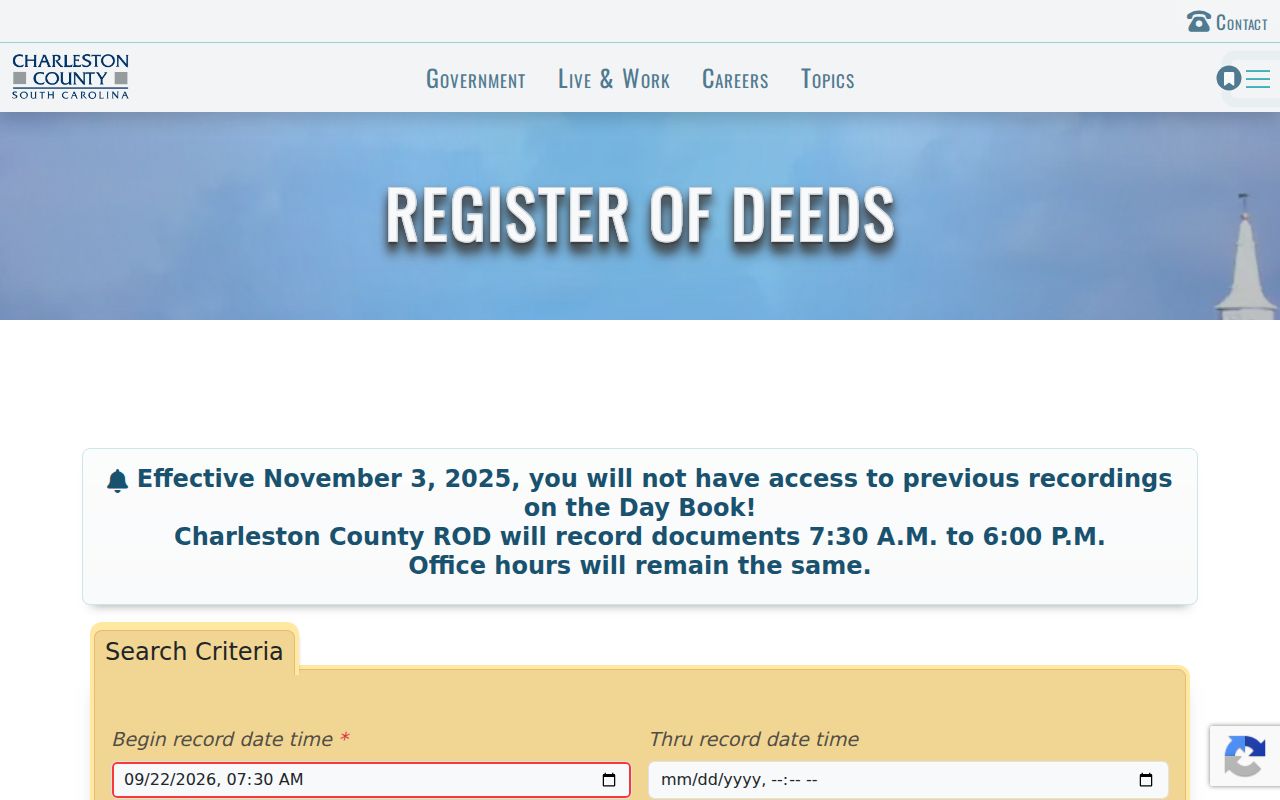
The Charleston Register of Deeds Day Book exposes a dated log of recent records, with maker and recipient fields and book references. The form below shows where those search limits go.
| Day Book field | Required | Use |
|---|---|---|
| Begin record date/time | Yes | Start bound. |
| Thru record date/time | No | Optional end bound. |
| Maker | No | Grantor or firm. |
| Recipient | No | Grantee or firm. |
| Instrument Type | No | Choose from the live list. |
| Show entries / Search | No | Control result rows and filter the table; Reset and page controls are also present. |
The captured Charleston Day Book result shows how an old transaction can be followed by its record reference.
Look for the record date and time, maker and recipient firms, instrument type, book-page, and original book and page. A deed image or tracer may add the property description, transfer terms, signatures, and liens, while older records need a courthouse, film, or archive route.
The Day Book is most useful as a locator when a recent recording date or party is known. Its start date/time field begins the window; the end date/time is optional; Maker and Recipient narrow the log, while Instrument Type and the table filter help sort the displayed entries. The result references the original book/page, which can lead to the actual instrument. That log does not cover the entire historical deed chain, so a pre-index transfer still needs the appropriate county book or film series.
South Carolina Directory and Census Years
A deed names legal parties. It does not list every person who used the address. Columbia’s digitized city directories cover 1859 to 1927; other South Carolina towns appear in a searchable USC collection from 1859 to 1922, with a different run in each place. A reverse or criss-cross directory may lead from an address to a listed adult. The South Carolina city directory collections page explains how to find the shelf and read a page.
Federal census pages add a household snapshot, and the latest release currently open to the public is 1950 under the 72-year rule. Compare a directory year with the nearest census year, but allow for a move between counts. Record the address, spelling, occupation, spouse note, book year, and page. A missing name may mean the person was outside the directory’s city area, the volume did not survive, or the index missed a letter.
For example, the Columbia 1905 volume includes short residence notation and spouse names in parentheses. Those clues can help distinguish two people with the same surname, but the book still reflects a city-limited listing rather than every person in the household. Census schedules add age, relationship, occupation, and residence on the enumeration date. Keep the exact schedule year and directory page beside the address so a change between editions is not mistaken for a same-year move.
South Carolina Past Residents in Probate Records
When a former owner died, a Probate Court file can connect the deed chain to a will, personal representative, heirs, or deed of distribution. Search by decedent, estate number, representative, date filed, or date of death when the county portal allows it. Richland’s subscription service has separate Probate choices; older files may need approval, a courthouse visit, or a written request. A public petition may show an old address, so do not treat it as a current one.
Obituaries, cemetery records, and local papers can help establish when a household moved or ended. SCDAH holds will transcripts from 1782 to 1855, and local newspaper, library, and FamilySearch collections vary by county. Use the last address, executor, and property description to test a family link. For who appears along the property now, switch to the South Carolina street directory record chain.
Probate is a useful endpoint because a petition or deed of distribution can name the personal representative, heirs, and property being transferred. Start with the county Probate Court that handled the estate and ask whether its index is online, subscription-based, or available at the courthouse. A will transcript in the Archives index may lead to a file reference, but it is not necessarily the complete estate packet. Compare the decedent’s last known address and parcel description with the ROD transfer before linking an heir to the property.
Marriage and death records route through different custodians: pre-July 1950 marriage licenses are with the county Probate Court, while DPH holds central marriage files from July 1, 1950. DPH divorce reports begin July 1, 1962, but the divorce decree remains in the Clerk of Court file. Recent birth and death certificates are restricted, so a directory, obituary, or older genealogy index may be the right public lead while a certified record is unavailable. Do not treat a public index entry as authority to obtain a confidential certificate.
Track South Carolina Past Households
Ownership and residence are separate trails. A deed shows the legal holder; a city directory can list the adult linked to a street in a certain year; a census records people counted at a home on its census date. Previous residents can be absent from one source and present in another, so compare several records before tying a name to the address. Directories, census pages, and obituary collections are described in more detail on the South Carolina city directory page.
South Carolina’s Columbia directories span 1859 to 1927 in the USC/Richland set. The wider USC collection lists towns from 1859 to 1922, though each town has a different run. Pair the nearest directory year with a federal census release through 1950. Obituary and cemetery files can place a death or burial, while Probate records can identify an executor or heir. A move, a changed name, a missing volume, and a bad OCR match can all break the trail, so keep the year and page beside each note.
One practical sequence is current parcel, earliest available deed, directory entries around the known transfer years, census pages nearest those years, and then obituary or probate evidence when the family story calls for it. The deed answers who received a legal interest; a directory supplies a printed address clue; a census records who was counted together. They use different dates and boundaries, so note the source beside every name and do not treat one record’s silence as proof that a person was absent.
Keep a citation with each clue: county and portal, volume or case number, recording or publication date, page, and the spelling shown by the source. That makes it possible to correct a mistaken link when an OCR search has confused initials or a map has shifted the address. A family timeline should preserve uncertainty—for example, “listed at this address in 1905” is stronger and clearer than claiming a person owned or occupied it for an entire decade.
Lawful use. Use past-resident records for family history, property history, and personal research. Do not use an old address to track, threaten, or harass anyone; South Carolina law sets criminal limits on stalking and harassment.